- Spectacularly Unprofitable Tiffin Center
- Posts
- Running Atop the Arabian Sea
Running Atop the Arabian Sea
A Meditation on Movement, Stillness, and the City Where the Land Ends

Abhinav Jain
February 18, 2026

I want to start with the disclaimer that this is not a "why I run" piece. I haven't read any books on running, and the articles I did read had no part in convincing me to run this half marathon. I can explain why I started running (which is very different from why I run now), but the reason is so petty that it might erase whatever little respect the reader has for me.
At the risk of losing that respect, here it is: I was never the "sports guy." Growing up, I was only picked for cricket teams because I could dive and hit the stumps from the point position—a human tripod of utility rather than talent. It didn't help that my height jumped from 5' to 6' only after 10th grade, right when I was locked away in "dummy" school. (Cue the JEE prep trauma). By the time I hit college, I was so obsessed with proving my worth after a mediocre five-digit JEE rank that I never even stepped inside the sports complex. I hear they had a world-class synthetic badminton court; I wouldn't know.
So, what does a 50kg (I have only recently gained weight), lean, long-legged boy do to reclaim his athletic prowess? He runs. That’s it. That is the depth of this entire facade. I don't believe you "find" yourself while running—if you do, I haven't yet.
The Gear Fiasco
With that out of the way, I want to document the Tata Mumbai Marathon 2026. It was my first half marathon, and my training peak was a modest 12km. To make matters more stressful, I had a "shoe-fiasco" a week before the starting gun.
My trusty Brooks Ghost Max—the shoes that saw me through my first year of running—were dying. Every time I pushed my pace sub-8 min/km, a deep, nagging pain radiated through my shins. It was either a Vitamin D deficiency (which has happened to me before) or a dead foam soul.
After discussions with my coach, I decided the solution was a shiny new pair of PUMA Deviate Nitro 3s. But then, the hubris kicked in. I’d always felt my size 9 Ghosts were a touch too loose, so I convinced myself that an 8.5 was the move. The moment they arrived and I laced them up, the realization hit like a truck: the Nitros were brutally narrower than the Brooks. The shin pain I was trying to escape only intensified. With the race bearing down and a size 9 replacement due a day after the marathon, I had no other option but to take a chance on the tight ones or risk my shins shattering in the old pair. It felt like a genuine sign of divine intervention when the size 9s showed up a good two days early.
Mumbai: The First Encounter
I settled into an Airbnb in Mahim, two kilometers from the causeway – the starting point of the race. While there were closer spots, this one offered something I’d never experienced: an uninterrupted, glorious view of the Arabian Sea.

You have to understand—I am a product of inland grind. Before this trip, I had never seen a large body of water. I’d never seen a sea, an ocean, or even flown over one. To me, "blue" on a map was a theoretical concept. That evening, I stepped out for a tentative jog in the new shoes—my first-ever run in them–and was still very nervous about the fit. I was nervous still when I reached the starting corral for my wave and began warming up.
The Strategy
I won’t bore you with the "what-could-I-do-better" analysis. My strategy was pure survival and logistics:
Nutrition: One gel every 30 minutes (alternating caffeinated/caffeine-free).
Hydration: One salt capsule every 30 minutes.
Cooling: Keep the neck, elbows, and shoulders wet at every station.
Pacing: Maintain between 6.2 min/km and 7.5 min/km.
I executed it all. My only regret was not fully opening the throttle after the 17km mark, simply due to inexperience and not knowing my body's limits.
The Experience
I took my initial salt cap and caffeinated gel as we stood in the corral, thousands of us patiently waiting for the starting gun. In all my races—granted, the sample space is a grand total of three—I always begin with a long-form podcast. It helps me stay steady and anchors my pace during the long, monotonous middle chunk of the run. I usually save the "uppity" Bollywood motivation for the fag end of the race, when I actually need to speed up; at the 18km mark, Aarambh Hai Prachand is much more in sync with my motion than two guys blabbering about GST reforms or Greek mythology.

For the TMM, I settled on Manoj Kewalramani’s "Primer on China" on The Seen and the Unseen. As the race began, my confidence in the new Pumas rose. They were holding up! We hit the Bandra-Worli Sealink around the 3km mark, and everything became breezy and surreal. I was running at a great pace, almost unconsciously, as I learned about ancient Chinese kingdoms and the eventual rise of Mao, Deng, and Xi.
The infra-nerd in me was having a field day. I could appreciate the structural beauty of the arch hangers and stay-cables even as my legs began to feel the distance.

The rhythm became mechanical: Run. Check the watch. Grab two bottles of water at the kiosk. Swallow the salt cap. Tear the gel. Drench your neck with the second bottle. Repeat. The first 10km went by like a breeze. For a total of 14 kilometers (give or take), we were running atop the Arabian Sea. The sensory overload was incredible. I watched the Marathi guards manning the apartment complexes near the Worli Dairy, shouting, "Kāya hōta āhē?" as we shuffled past. I hit the dreaded Peddar Road just as the city truly awoke, greeted by locals holding thaalis of peeled orange slices and signs that read: “Climbing Peddar? You must be madder.”
Near the end, I passed the many gymkhanas of Bombay and thought of all the stories I had read about Mumbai cricket and why it holds its stature. All the gymkhana maidans were buzzing with at least five or six different teams, all playing their hearts out at 7 in the morning. I didn't expect anything less from them. I saw the lines of kaali-peelis parked along the streets and felt that same cinematic awe Margot Robbie had when she first saw those "American" red solo cups in real life. It felt iconic because it was finally real.
The Finish

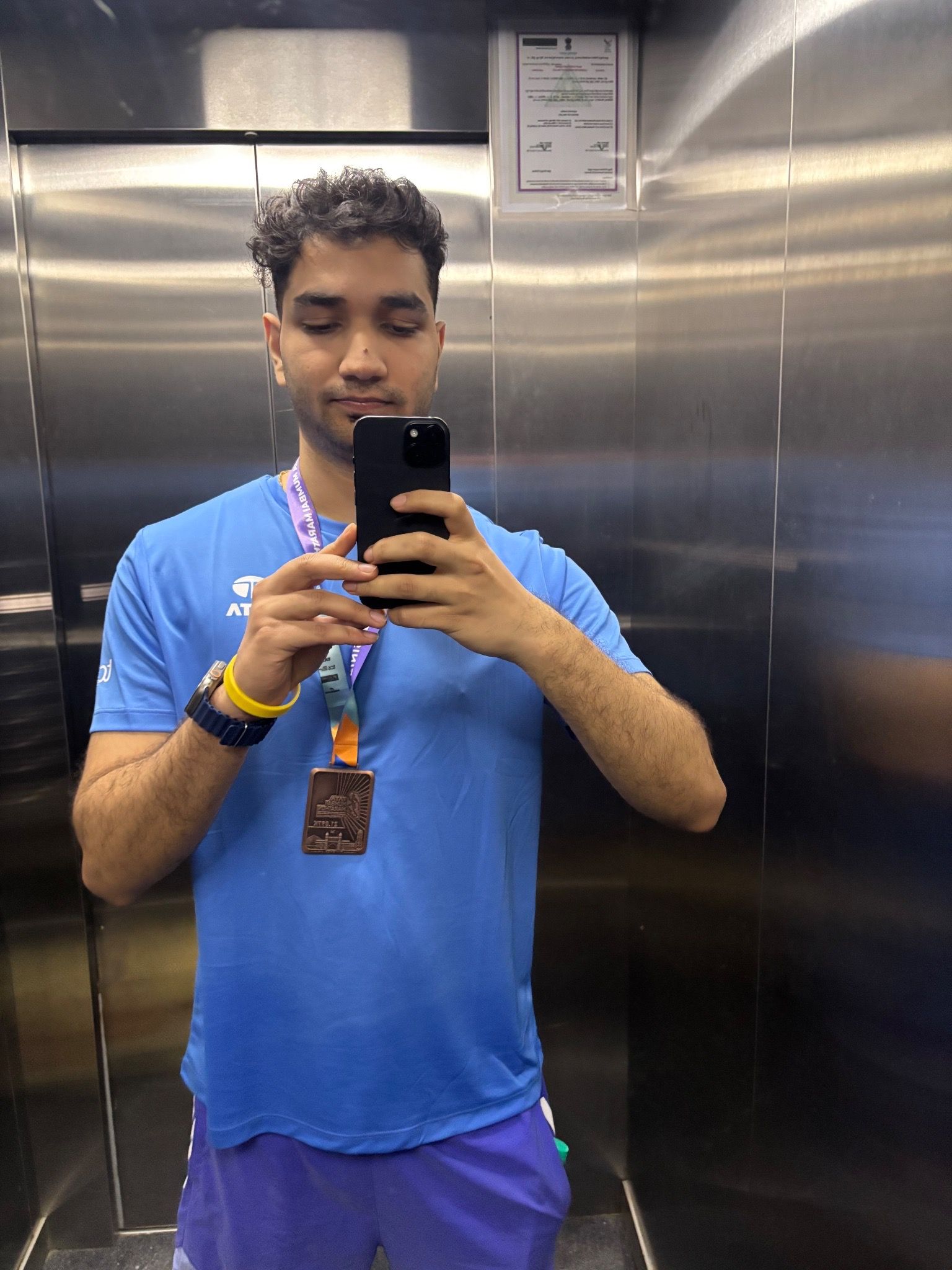
I finished the half marathon in 2:37:47. I didn’t have a specific time goal, but I was quite happy that I never had to take a walk break during the entire 21 kms. After "carb-maxxing" at Azad Maidan, with a medal around my neck that felt much heavier than it looked, I caught a "slow" local train to Matunga station.

As the wind whipped through the open door, a barrage of movie scenes flashed through my mind. The Mumbai local is arguably the most filmed stretch of track in the world, and I found myself romanticizing the commute just like the countless directors before me—most recently the blue-hued train sequence from the opening of All We Imagine As Light.
I took a cab for the final 200 meters from the station to my Airbnb. It felt ridiculous, but after 21 kilometers, your legs cease to be body parts and become purely decorative ornaments. I wouldn't have used them for another meter for a million dollars.
I sat by the living room window and looked back at the water. The morning sun was hitting the surface, turning the Arabian Sea into a shimmering string of pearls. For a boy who spent his life looking at textbooks and badminton courts he never used, the horizon finally looked reachable. I’ll always believe it was the sea that pushed me further than my limits.
Appendix: Photos


Reply